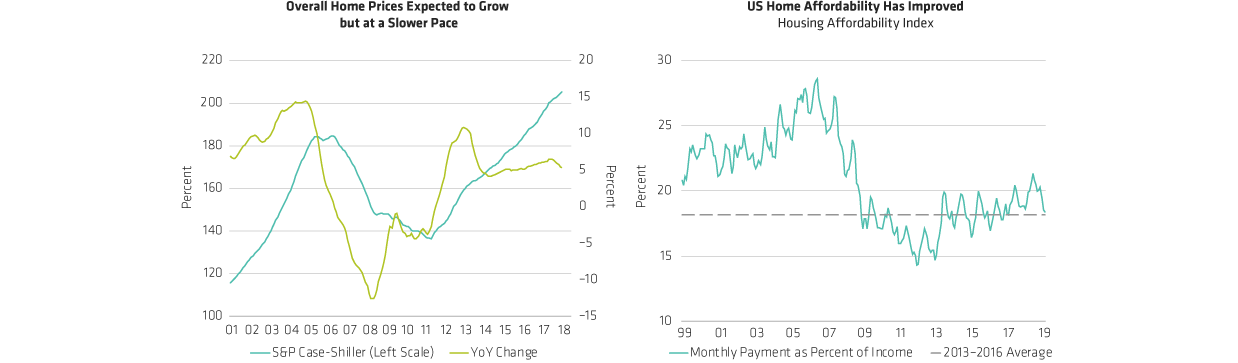
As a result, we still see opportunity in CRTs, issued by US government-sponsored enterprises Fannie Mae and Freddie Mac. These assets pool thousands of mortgages into single securities that provide investors with regular payments based on the underlying loans’ performance. Unlike typical agency bonds, CRTs don’t carry a government guarantee, so investors may absorb losses if large numbers of loans default. Even so, high borrower credit quality makes CRTs attractive; many have been upgraded to investment-grade status.
CMBS are also attractive and offer a healthy yield pickup over similarly rated corporate bonds. Investor worries about CMBS—particularly those backed by shopping malls—have driven down prices, making many attractive opportunities for investors who can do their homework. But it’s important to be selective because credit fundamentals have deteriorated for securities issued after 2014.
On the higher-quality side of the scale, investors may want to consider higher-quality CMBS, highly-rated collateralized loan obligations, agency mortgage-backed securities from Fannie and Freddie, which carry a government guarantee of principal, and select exposure to consumer-oriented consumer asset-backed securities (auto and consumer loans).
Complementary Income and a Smoother Ride
Much like a traditional credit-based income approach, the manager of a mortgage income strategy can adjust the balance between high-quality assets and higher-yielding ones as valuations and conditions change.
Just as important, securitized assets have exhibited a low correlation with government debt, which plays a key role on the risk-reducing side of the traditional credit income strategy. They’re also relatively uncorrelated to credit and equities, making them a powerful portfolio diversifier.
The way we see it, pairing credit- and mortgage-focused income strategies in a single portfolio can help generate decent income and reduce drawdowns.
The global outlook is increasingly uncertain, and with no end in sight to the US-China trade war, we expect high volatility to persist as we head into 2020. For income-oriented investors, that scenario will require some creative thinking. A “satellite” allocation to mortgages may help investors cushion a more traditional income allocation that leans heavily on high-yield bonds.